While I was visiting the HQ of a major cycling apparel brand
last year, I was able to visit their safety department. I noticed vast
quantities of helmets in various states of damage laying around, which shocked
me due to the value of these items alone. This got me thinking about the
investment by companies in safety, so in desperation to find another topic here
we gooo.
Firstly it’s worth setting the expectation that (in my
opinion at least) safety, much like health, does not have a quantifiable value.
So any investment to make sure the end-user of a product is safe from harm must
be worthwhile. For simplicity, I looked only at the automobile industry, as I’m
sure it is the most applicable to anyone reading this article. Companies run
multiple tests to meet various requirements, and be confident in the fact that
they are releasing a safe end product.
The key types of ANCAP safety tests are:
Frontal offset tests – i.e. a car hits a barrier head-on at 64km/h
Side-impact tests – a trolley (950kg) is rammed into the driver’s side door at 50km/h
Pedestrian Test – measures the impact of a collision with a person at 40km/h
Whiplash Test – measures the impact on the driver when their (stationary) car is hit by another at a speed of 32km/h
ANCAP Safety testing in action
Obviously, they can’t perform these tests with actual people
in the vehicles, so they use crash dummies. These are incredibly intricate
structures, with sensors placed at points critical to human survival in a
crash. The cost of these dummies can range up to one million dollars apiece,
evidence of how much research and development goes into their construction.
This is a major part of the cost throughout this process, but in addition to
this, we have the subject of the testing itself: the vehicle. Cars aren’t
cheap, especially when you have to destroy multiple to satisfy test
requirements. One of the key USA vehicle testing agencies, MGA Research, crash
test over 300 vehicles per year, so you can understand how some huge costs can
accumulate.
The cost to the company is usually best discussed relative to its revenue, but I dropped my BCom conjoint for a reason so I’m not going to talk about that. Instead, I’ll leave you with the knowledge that a lot of money is spent to keep us safe while travelling.
This time, it’s time to celebrate (and playfully criticise) two femme fatale powerhouses.
From the Marvel side, it’s fighter pilot and space cop extraordinaire Miss Carol Danvers – Captain Marvel. Captain Marvel uses the energy of light – absorption and emission – to project powerful blasts and is also able to unleash a ‘Binary’ form where she becomes pure light energy.
Captain Marvel in the comics and in herBinary form, as well as her portrayal in the MCU by Brie Larson.
Surprisingly, this is a relatively sound idea. Atoms exhibit this photon emission and absorption – its why a piece of metal glows when it’s hot. The electrons in an atom are all at different energy levels, and if an electron drops from a higher to lower energy it must then release the excess energy because energy can’t be destroyed. So this energy becomes a ‘particle’ of light, or a photon, making the metal glow brightly. Technically if Captain Marvel could manually do this, her powers make sense – and given that she is infused with Kree alien DNA it doesn’t seem too illogical. Unlike the last two heroes, Captain Marvel doesn’t seem to be abusing physics (genetics however…)
Verdict: Slip, slap, slop and put on sunglasses… you don’t want to be getting a cosmic sunburn.
Next up is one of the most powerful members of the Justice League, leader of the Birds of Prey, wearer of impractical outfits and someone you really don’t want to make scream. Dinah Lance, also known as Black Canary is a metahuman from the DC universe who possesses the ability to unleash sonic energy as a scream, powerful enough to shatter metal.
Canary in the comics, the fighting game Injustice 2, and the TV series Arrow (portrayed by Katie Cassidy)
While Captain Marvel uses light energy, Black Canary relies on the energy from sound. Sound waves are, microscopically, vibrations of air molecules. When these air molecules vibrate, regions of space have lots more than others making them have a higher pressure. If a sound wave had enough energy, this would give rise to the effects of Canary’s powers. The only problem seems to be how the wave she creates doesn’t destroy her own throat while travelling through her body.
Everyone knows that burning of fossil fuels is bad for the environment, in recent years electric cars have been becoming much more popular in a global green movement. So how eco-friendly are these vehicles.
While the use of an electric vehicle has practically no carbon emissions, the electricity used to power it still isn’t perfect. The majority of electricity generated in the world comes from the burning of fossil fuels so electric cars don’t win by a huge margin here. However every year the world uses less fossil fuels, so this will only get better over time.
The production of electric vehicles is their biggest downside. The carbon emissions for producing a battery is similar to that of producing the rest of the car. So producing an electric vehicles releases twice as much carbon as producing a conventional car.
Overall in their lifetime, electric cars do produce less carbon than conventional cars, how much less depends on how much of the electricity you use is renewable. This varies a lot between different countries. So you shouldn’t just ditch your old car for an electric one as the production of cars is a large proportion of their carbon emissions.
Misinterpreting the outcome of a medical test can be problematic. Medical testing usually have the problem of false-positive, which describes the situation of wrongly indicate a medical condition is present when it is not (which involves some basic statistics).
In a medical test for whether a person has a particular disease or not, the outcome is either positive or negative. However, even if a medical test has a high sensitivity rate (the probability of testing positive if one person has a particular disease), test-positive does not guarantee the person has the disease. In fact, the ‘chance’ of actually having that particular disease given test-positive, can be very low. The determining factor of the accuracy of such tests is the prevalence rate – how prevalent a disease is among a particular population. To illustrate, I made a table to display what I mean.
(You can skip this section and jump to the conclusion if you don’t like probability calculations)
According to a study from the UK, about 0.6% of the population develop brain cancer in their lifetime (which is roughly 60 in every 10000 people). The current technique for a blood test for brain cancer has a sensitivity rate of 83.3% (for calculation reasons, I will round it to 90%), and specificity rate of 87% (which I will round to 90% as well). [Specificity rate describes the probability of test-negative given a person doesn’t have a particular disease].
Suppose 10000 people took the blood test,
Test Positive
Test Negative
Total
Have brain cancer
54
6
60
Don’t have brain cancer
994
8946
9940
Total
1048
8952
10000
Suppose you are one of 1048 people who test positive. You shouldn’t be too worried about the outcome because there is only a 5% chance that you have brain cancer. (54/1048 =0.05)
Conclusion: What this demonstrates is a misunderstanding of conditional probability. The probability of ‘A given B’ can be very different to the probability of ‘B given A’. The reliability of a medical test (the probability of actually having the disease given test positive) is hugely affected by the prevalence of the disease. No matter how high the sensitivity a medical test is, there is a good chance for it being wrong, given a low prevalence rate of the disease. So we should be suspicious when making decisions based on the outcome of medical tests.
This semester I started trying to learn Italian, the first time I’ve somewhat-seriously attempted learning a language. My usual strategy for learning is to understand content as it’s presented and cram before assignments, tests, and exams. For most subjects I take (sciences) this work well. The most important, and difficult, part of the content is conceptual. Memorising formula, conventions, and other behaviour can be done as needed. I knew this wasn’t going to cut it for Italian. For one, there’s far too much to memorise in a couple of days. So I tried a new approach, flashcards. I usually only use paper for mathematics & diagrams and use digital resources for pretty much everything else. Hence, I set out to find a flashcard app.
Anki & Spaced Repetition
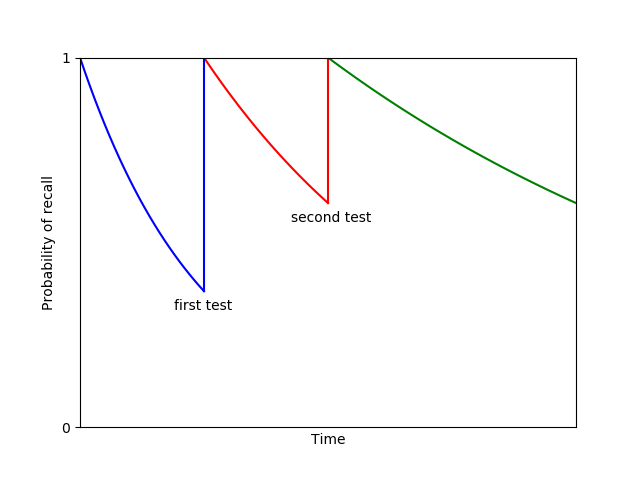
After some research I found Anki which is a strong supporter of a concept called spaced repetition. To understand spaced repetition it makes sense to first look at how memory works. In the 1800s Hermann Ebbinghaus ran some experiments on himself, memorising meaningless syllables such as ‘WID’ or ‘ZOF’. He recorded when he forgot these and they needed to be relearnt. Ebbinghaus modelled the probability of successful recall over time as an exponential decay function which looks something like this:
This is now known as the ‘Forgetting curve’. You can see that each time information is forgotten and relearned it will be remembered slightly longer. This is the principle behind spaced repetition. If you know the curve you can tell when each flashcard should be reviewed to achieve an average recall of, say, 90%. Anki does all of this for you. When it shows you a card you have two to four options:
Again
Hard
Good
Easy
The longer a card has gone without being forgotten (not picking ‘Again’) the longer it will be before Anki shows it to you again. On the other hand, if you forget a card this time resets back to the start.
My Experience
As of this post I have 922 cards in my Italian deck. 541 of these are ‘mature’, 350 are ‘young’, and 24 are ‘suspended’. The vast majority of these cards are just single words. Common verbs, nouns, adjectives, etc. Some of them are more interesting, such as the cards I use to memorise conjugations. These have a verb, tense, and a place to write in the conjugation for each of the six subjects.
Ideally, Anki works best if you review cards each day and introduce some small number of new cards each day (20 is the default). When I committed to this I didn’t find it that difficult. However, when the first test approached I added a large number of cards. Realising I wouldn’t see them all before the exam I panicked and increased the new card limit to 40, then 80, then 100…
Then the exam hit and I lost all motivation to study. Highest peak on that graph is one day in the holidays where I paid for all the reviews I had missed. That day I reviewed about 750 cards taking me almost two hours. After the holidays I eventually got back into the habit. In the second half of the semester we weren’t introduced to that much new vocab, hence the smaller number of new cards. Overall I’ve spend approximately 14 hours studying these cards, studying an average of 20 minutes a day. Anki helpfully tells me (I imagine in the tone of a used car salesman) that this could be as low as 11 minutes if I studied every day. The average time between seeing a card in my deck twice is 1.3 months. The longest card has an interval of 5.1 months. ‘Finire’, to finish.
It’s Not A Silver Bullet
Unfortunately, as useful as spaced repetition is, it’s not a silver bullet. Here are four things you should know before you try spaced repetition yourself:
Anki is not designed to help you learn it’s designed to help you remember. You should ideally have already seen the word/formula/thing at least once before you create a card for it.
Creating good cards take time. For vocabularry you can often get away with just the word on the card. As soon as it gets more complicated than that cards like this will be very difficult to remember. Which leads on to:
Adding context, pictures or diagrams will make it much easier to remember. Connections to things you already know help enormously in recall.
Don’t add too many new cards at once. For me, about 50 new cards a day on top of regular reviews is about the limit. More than that and the number of reviews becomes overwhelming and I get burnt out. Find your limit, and stick to it.
An Ending
I’ve learnt a lot using Anki and even if I decide to stop reviewing my Italian deck after exams it’ll be a useful tool to have whenever I have something I want to remember.
Millions of asteroids of all sizes make their way towards earth. Most of them are smaller than pebbles and disintegrate in the upper atmosphere of earth. Very occasionally a much larger asteroid will come past. For example the 10km wide rock that ended the reign of the dinosaurs. The questions becomes, if we detected a large rock that was going to hit earth, would be be able to deflect it.
While Earth may seem pretty large to us, on the scale of the solar system it is just a speck, if an asteroid was on course to hit earth in a year then we would only need to change its velocity by about 3.5cm/s. This may not sound like much but if it weighs 10^15kg (more than one million Empire State buildings) then this may be a bit of a struggle. Perhaps the most effective method would be to use nuclear weapons. If we could get a space ship to fly along side the asteroid and detonate a few explosions then this would probably be enough to deter it.
The chances of such an event occurring as incredibly low, asteroids large enough to be worth deflecting impact earth around once every 100,000 years. And humans only live on approximately 10% of the earths surface anyway. But we can never be too careful, we need to make sure we are ready for this when it happens.
Sports have been a part of human culture for millennia, competitions are used to find out who is the best. There are many factors that contribute to how well a person can do in their chosen discipline. Top athletes will do everything they can to try reach peak performance, training for hours every day and eating the perfect diet. However there is only so far you can go before your body will not let you go any further. In today’s environment, to be the best of the best you have to have a genetic advantage over everyone else.
Gene doping is a hypothetical way to permanently edit an athletes DNA, allowing for endless possibilities to improve performance. Unlike most performance enhancing drugs this may be almost impossible to detect as the modified DNA appears as a natural part of the body. This arises some debate as to what we should do once this technology becomes usable. If there is no way found to catch people doing it then perhaps the only way to keep sport fair is to allow it, so that we have an even playing field.
Despite many man made substances being developed such as Teflon (Coefficient of friction(CoF) = 0.05) and BAM (CoF: 0.02), the combination of synovial fluid and articular cartilage in synovial joints of the human body with a CoF of 0.002 is one of the closest substances to being completely frictionless. A property that is essential when you consider the forces that our joints experience all day everyday.
A joint is the point at which two bones are connected in the body. They must have a good range of motion but also be very stable. Being frictionless is essential to ensure fluid movement and also to prevent the wearing down of the ends of the bones due to constant movement between the ends of the bones throughout your life. Synovial joints are made up of: an articular capsule which holds the ends of the two bones together, articular cartilage which protects the ends of the bones and a joint cavity which contains the synovial fluid.
Despite all the modern technology engineers are yet to create a surface so close to being friction less which can be used in artificial joints such as knee and hip replacements. It is also hard to find a substance that is long lasting – synovial joints usually last for about 60 years before the cartilage is worn down to reveal the bone underneath. This wearing down of the cartilage to expose the two bones of the joints to each other is what is known as arthritis.
This displays just one of the marvels of the human body and shows how much we can learn from the way our body operates.
A few weeks ago, I had a crisis.
I was not sure what I wanted to study anymore. For years I was sure that Physics
and Maths was where I wanted to be, and it took until I felt completely unsure of
what I was doing that I finally sat down and thought about what I was good at,
what I enjoyed, and where I wanted to be in the future.
I decided that Maths was no
longer right for me, the proofs and abstraction were turning maths from the
beautiful engine that makes the world tick into a complex monster that could
not be wrestled under control. Statistics came to mind, and after a bit of
research into what studying statistics could offer me, I found myself falling
down a rabbit hole. I realised that I had been pursuing interests in statistics
without noticing it. I was obsessed with data analysis and I had not even
noticed. I realised I had always taken on the task of processing the data
tables in group physics assignments, and I loved every second of it. Whilst the
research and discovery still interested me, my true fascination was with data
and having the skills to make conclusions based on my observations of said
data. Whilst I haven’t yet had the chance to take a statistics course, I have
found myself looking at the content of the courses, and teaching myself R, the
statistics computation software designed by Ross Ihaka and Robert Gentleman, former
lecturers here at the University of Auckland.
The reason I want to bring all
this up is I had gotten it in my head that once I said I wanted to study something,
I had to follow it through, no matter how I felt about it, and I’m sure I’m not
the only one who thought that, and I’m sure there are some people who still
think it. So I want to encourage you all to think about what you enjoy, because
whatever you end up with a degree in, it’s likely that you will be working in
that area for most of your life, so it really should be something that you are
obsessed with, or you are going to find yourself rather frustrated in a few
years time.
I don’t know about you but as an 8 year old I was very disappointed to find out that even after eating 3 carrots in a row I was unable to see clearly in a pitch black room 😥
However it turns out that this fib told by parents as one of the many ploys used to get kids to eat their vegetables isn’t completely false. One of the active forms of vitamin A (a fat soluble vitamin found in high quantities in yellow/ orange fruits and vegetables such as carrots), all-trans retinal, can be converted in the human body to a form called 11-cis-retinal which is used in the formation of a pigment called rhodopsin.
Rhodopsin is found in the rods in the retina of the eye and is tasked with capturing light energy and converting it into a signal. It is very sensitive and therefore able to sense even low levels of light. However without the presence of 11-cis-retinal rhodopsin is unable to be formed, thus resulting with visual difficulties in low light conditions.
Therefore although eating more carrots can’t improve your night vision, a vitamin A deficiency will decrease your vision, so the moral of the story, as always, is: eat your vegetables!




 Science Scholars 2019