NASA has released a collection of audio recordings from Mar’s surface which reveals the sounds of weather, seismic events and other unexplained phenomena which were described as “peculiar” as they could not be easily explained. (Aliens?) The sounds were actually nicknamed “dinks and donks”.
They utilised a tool called a Seismic Experiment for Interior Stricture (SEIS) to capture the audio of weather and seismic activity of Mars. This tool has a dome-like shape and sits on the surface of Mars, using wind pressure, magnetic sensors and temperature to help the seismometer in detecting dust storms, meteorite impacts and even marsquakes (yes, apparently earthquakes aren’t earthquakes everywhere).
What information they can gather from the SEIS will enable scientists to discover how Mars formed and evolved.
It’s interesting to hear what life is like on another planet and realise that on a planet devoid of life, the only thing you can hear is the relentless wind…and some peculiar dink donks of course.
If you’d like to listen to the dinks and donks yourself, here’s a link:
Watersports and boating have always been a major part of people’s lives in NZ and we are pioneers in many sports such as sailing and have a world class boat building industry. For a long time boating and water sports have been limited by the need to travel through water by displacing water and dealing with the large friction forces. This has led to power boats that are not very fuel efficient and travel very slowly compared to other vehicles, and yachts utilizing wind power that travel not much faster than a snail.
Foiling mono-hull
But don’t worry, we have been saved by the creation of the hydrofoil as seen in the pictures. Hydrofoils extend below the vessel and have wings that when moved through the water produce enough lift to lift the vessel out of the water resulting in the ability to almost fly over the water at incredible speeds due to the greatly reduced friction forces and not having the hull of the boat sitting in the water. The most well-known application of foils is on the Americas Cup boats where we have had both catamarans and mono-hulls that are roughly 70 feet long a few meters above the water on foils travelling at speeds of over 80kmph. This is an area where NZ engineering has excelled and Team New Zealand are at the forefront of foiling technology and will be defending the Americas cup in 2021 here in Auckland!
Kite foil racing
As an avid kite boarder, my recent progression with learning to foil has been absolutely amazing: the feeling of flying a meter above the water travelling over 50kmph is a dream come true and one of the greatest feelings in the world. I strongly urge everyone to take the opportunity to experience the magic of foiling for themselves, be it kite foiling, windsurfing or wakeboarding on a foil, or having a go on a foiling yacht or even a foiling ferry. Get out there, try it and you will become addicted!
As we all
know, since the development of the Ford model T which was the first mass
produced car in the early 1900’s, the automobile has transformed the way we
live, shaped the cities we live in and has had a major effect on the lifestyle
of us all today. This is especially seen in the layout of Auckland city and
along with our shocking public transport living in Auckland really expresses
the demand we place on cars as our main form of transport. But along with the
rapid growth that cars have brought to our cities, they are also potentially
contributing to the destruction of our planet by burning fossil fuels as their
primary fuel source. As a car lover and petrol head I find it sad to see the
inevitable extinction of the combustion engine but I believe that sooner or
later it is necessary in order to not destroy the very planet that we occupy.
There are a
few options that act as replacements for the combustion engine that currently
powers most cars on the roads today: these are mainly either electric, hybrid,
or hydrogen fuel cell cars. They all have their advantages and disadvantages
but for the most part produce less greenhouse gasses than the current cars on
the road today.
Most people
are probably familiar with both electric and hybrid cars which are increasingly
being produced and are gaining traction with consumers. Fully electric cars
such as the Tesla models utilize an electric motor and they store energy in
lots of batteries similar to your phone. Hybrids are similar as they have both
an electric motor and a traditional combustion engine that when used together
achieve very high efficiency. Hydrogen powered vehicles are less common and
produce electricity to drive electric motors from hydrogen stored in a tank on
board – similar to storing petrol in your fuel tank.
Although these new electric cars have the capability to be extremely fast due to the way electric motors produce instant power and torque, there is still something about the love of the noise, raw power and thrill of working on petrol engines and seeing the things roar into life. Maybe one day we will invent an alternative that produces that same spark in enthusiasts worldwide such as petrol cars have done. But until then, we do need to save the planet from major issues, and that is just a compromise petrol heads will just have to make.
I believe the building blocks that make up who we are are essentially our past experiences, memories and the world around us that we have been exposed to. These vital aspects of our past build our perception of the world around us, our place within it and ultimately control our behaviors, opinions and beliefs. Throughout history there has definitely been a major advantage to learning from others, especially during the early years of childhood, and this contributed to the development of many technologies and the use of tools in early humans. But in the last 100 years with the increased exposure to publicity – be it newspapers, magazines, TV’s, music, or the recent rise of social media – our understanding and interaction with the world around us has transformed from real person to person interaction to a more controlled, virtual space. It is a very scary thought that companies such as Facebook or Google may have control over the communication and beliefs of billions of people; control and power of this scale is unprecedented in human history and I believe that if we aren’t careful we will go down a dark, unrecoverable path where the essence of what it means to be human is lost to power, control and profitability.
Children
these days have swapped playing outside learning the mechanics of the real
world for an easier and simper virtual world of cartoons and games. I believe
that this will have a detrimental effect on the way people on a mass scale
behave and the way people form and act on various beliefs in the future. The
main issue is that those in control of the way people are thinking don’t
necessarily have the greater good (if there is such a thing) in mind and have
an objective of making profits.
Over the
last 50 years various forms of technology and electronics have become an
increasingly important aspect to the functioning of society. And with the
recent and rapid introduction of smartphones which have cemented themselves as
a vital part of the framework of our lives, there is the ability to develop
more and more software to expand on current functionality and keep increasing
the role that technology plays in the fabric of society. But with each
advancement to technology, we leave a part of the real world behind. I just
hope that we don’t take it too far to the point where we transition from being
humans interacting in the real world to living completely in a fabricated,
manipulatable and fake virtual world.
Science is essentially a collection of ‘best guesses,’ theories which explain what we observe until another theory comes along to explain it even better. String theory is a great example of this; a theory created to explain some things we don’t understand, but it still has some inconsistencies which are yet to be figured out.
Our current understanding of matter is that the smallest fundamental building blocks are the ‘elementary particles’: leptons and quarks which make up all protons, neutrons, and electrons. This model describes all these particles as points with a specific mass and charge. However, a problem arises when trying to understand what causes gravity. A hypothetical particle called a graviton is thought to cause gravitational forces, much like how photons are responsible for electromagnetic forces, but with the current model the math simply doesn’t work out. A new model is necessary, and thus string theory was born.
String theory suggests that, rather than a point, these elementary particles exist as vibrating filaments or strings. The frequency at which each string vibrates determines which particle it produces. This works really well to explain not only matter (that is, the quarks and leptons), but also radiation (gravitons and photons), so the mystery of gravity would be solved.
There’s only one problem – this theory requires the existence of ten dimensions of space, as well as one dimension of time. I agree that 11 dimensions sounds crazy at first, but it turns out that this is more likely than it may seem. Think about when you see a wire from far away, and it appears two dimensional. Then, when you get closer, the third dimension becomes visible. So the missing seven dimensions could just be so tiny that we haven’t been able to see them yet, folded up on each other and tucked deeply into space. This is hard to imagine from a 2D image, but this photo shows one idea of what the hidden dimensions could look like!
Figure 1: Ten dimensional spacetime (A. Hanson, 2011).
Why are we still not sure what elementary particles are made of? Essentially, they’re so small that observation is impossible since the wavelength of light is too large to hit them, and creating a wave with a small enough wavelength requires so much energy that it will mutate the particle. Instead, the answer may lie in the large hadron collider. One goal of the collider is to demonstrate the existence of extra dimensions by slamming particles together at incredible speed. It’s hypothesised that this could cause something from the particles to enter another dimension. If energy is lost during a collision, this would be evidence of extra dimensions and support of string theory. However, in the ten years since the construction of the collider, no such evidence has been found…yet!
Here are some fascinating YouTube videos if you’re interested in learning more:
Have you ever been really stressed and had someone tell you to ‘just breathe?’ As annoying as this can feel in the moment, they actually have a good point! Deep breathing has been found to reduce anxiety, stress and fatigue. When we’re anxious we naturally take short, quick breaths, exhaling more than we inhale. As a result, carbon dioxide levels plummet, and this causes a narrowing of blood vessels so that less blood can reach the brain. However, using your diaphragm to take deep, belly breaths encourages full oxygen exchange which slows the heartbeat and stabilises blood pressure.
However, this is not a new discovery. Many cultures have understood the power of breath for many years. Traditional yoga uses ‘pranayama’ in coordination with movement, while the Chinese practices of tai chi and qigong also have their own deep breathing methods.
One popular method today is the 4-7-8 pattern; breathing in for four counts, holding for seven, then releasing slowly for a full eight counts. Why not give it a try? Wherever you are right now, sit a little taller and relax your shoulders. Focus your breath towards your belly and just observe how it makes you feel.
You’ve probably heard of the Myers-Briggs personality test; it’s one of the most common personality test used all over the world.[1] I have definitely seen it a lot over the years, with school careers advisors, in leadership courses, and of course every time a friend asks me which type I am and I have to take the test for the hundredth time because I can never remember…
Just in case you’ve been living under a rock, let me explain. The test gives you a score in each of four categories. Are you more extroverted or introverted, gather information from sensing facts or prefer to use your intuition, do you make decisions more by thinking or feeling, and do you prefer structure (judging) or flexibility (perceiving)? This results in 16 different personality types such as ISFJ, the artist, or ENTP, the debater.
The test was developed in 1943 by Katherine Briggs and her daughter Isabel Briggs Myers. They based it off the work of early psychologist Carl Jung who had, twenty years earlier, begun categorizing humans into 8 personality types. However, personalities are so complex that they cannot easily be categorised into any number of types. The questions and results in the Myers-Briggs test are binary and leave no room for nuances of the human experience. Carl Jung himself said that “every individual is an exception to the rule,” and called the classification systems “nothing but a childish parlour game.”[1] Katherine and Isabel had no psychology qualifications to validify their work, and it’s been found that only five weeks after taking the test, 50% of people will receive a different result.[2] So, how is this phoney test so widely used today?
One of our biggest desires as humans is to feel like we belong. We want to fit into a group, and the Myers-Briggs test works really well at this. Who doesn’t want to know that you have the same personality type as Walt Disney or the queen? Much like horoscopes, the results are vague enough that anyone could relate to any of the results. And furthermore, the descriptions are always positive, which makes us more likely to agree with them.
Even if the Myers-Briggs personality test is little more than a horoscope, I still think it’s an interesting way to get thinking about how others see the world and relate to people differently, as well as always being a fun way to spend an afternoon with your friends. Did you know I have the same personality type as Sansa Stark? 😍
Economics has long been criticized for being pseudoscience – it uses carefully designed mathematical models, yet very often fails to predict the future trend; it claims to study human behavior in a scientific way, yet fails to understand the messy nature of human beings. In this blog, I will argue why economics is a type of science.
Economics is science because economics aims to explain how the world works. This is what science does. Economics explains the world by developing economic principles (or ‘laws’), such as the law of demand. These principles are universal, meaning they work at all times. And economics uses both qualitative and quantitative approaches to analyze and make predictions. Moreover, economics applies its principles to make predictions about the world. What economics does is the same as what science does: generalizing universal laws, using laws to make predictions, and using qualitative and quantitative approaches. Economics, therefore, has the same aim and conduct as science.
Economics is science because economics has the key characteristics of science: being falsifiable, verifiable, and explanatory. Falsification allows economic theories to be proven wrong, therefore, there is always space to improve. Economics is verifiable because an economic theory or principle can be tested. It allows critic and challenge. And lastly, economics is explanatory. It aims to explain what is happening in the world, and trying to use generalized rules to help humanity. Since economics and science have the same key characteristics, I would conclude that economics is science.
Some might argue that economics is not science because it fails at making predictions and explain human behaviors. No economic model successfully predicted the 2008 economic crisis. I would argue that this claim is flawed science can fail to explain natural phenomena as well. No one really understand what dark matter is, so far it is only our prediction. Moreover, economics sometimes fails at explaining social phenomena because it is a relatively new discipline whereas science has been developed for a very long time. Therefore economics as a discipline has many problems that science has fixed. Therefore this critic of economics is not strong enough to say economics is not real science.
To conclude, economics and science have the same aim of explaining the world. Both of them use qualitative and quantitative approaches to generalise laws and use laws to make predictions. Economics has the key characteristics of science: falsifiable, verifiable, and explanatory. Therefore, economics is science.
Bubble nets hmmm… You mean, the small nets that you blow bubbles through? The ones you used to love playing with when you were a kid? No, unfortunately not.
Researchers. Scientists. People. They are the ones that are finding new ideas, new creations, new solutions to all questions and wonders we pose to the world.
Climate change and global warming is a hot topic right now and it is getting hotter. We all know what it is and how this generation is the one to suffer and untangle the mess (if we can!). Ecosystems simply shape our environment. Without them we wouldn’t be here. There would be no trees to help us breath. No food to help us eat. No water to help us drink. No nothing. No us. As a strong believer in environmental stability and care, I place a lot of value on the animals that make up these complex ecosystems – the humpback whale for example.
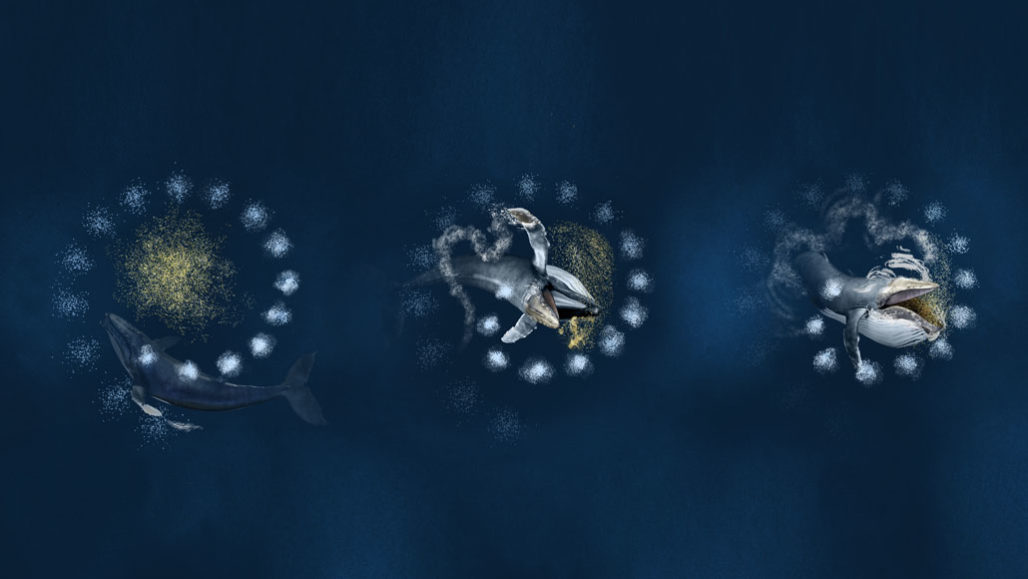
A humpback whale will blow a “net” made of bubbles and then splash its flippers at the net’s weak parts to reinforce them before lunging to swallow the captured prey (illustrated in yellow), a study finds. The research was conducted under NOAA permits #14122 and #18529.K. KOSMA/ROYAL SOCIETY OPEN SCIENCE 2019
The humpback whale also identified as Megaptera novaeangliae are large animals that need to eat a lot. They commonly feed by opening their large mouths and lunging towards fish catching any in its mouth on the way. Alternatively, the whales may swim in an upwards spiral blowing great big bubbles as they go. This creates a “circular net” of bubbles making it harder for the already trapped fish to escape.
Once the bubble net is made the whales will then splash their pectoral flippers upwards from the deeper water to secure the netting barrier and direct fish towards the whales mouth. Below is a video of what has been explained.
Visual showing
The humpback whale is just one of many organisms that has a fascinating and unique mechanism that enhances survival and its position in the food web/ ecosystem.
Imagine a 3 years old kid, who needs to use his finger to count numbers. How many numbers can he count up to? 10? 20? or more? Well, he can count up to 1023 if he knows binary ;).
So how does that work? What is Binary? Binary number is similar to decimal number. But instead use 0, 1, 2,…., 8, 9 in each digit. Binary only uses 0 and 1. When ever you count to 1, add a new digit and start counting again. For example 1001 in binary is the same as 9 in decimal (2^3 * 1 + 2^2 * 0 + 2^1 * 0 + 2^0 * 1 = 9). So using binary you can count to 1023 (decimal) using only your hand. Since each finger can represent a 0 or 1. You have 10 fingers. Therefore you can use your hand to represent any binary number less than 10 digits. Which is 2^10 – 1 = 1023 many numbers.
Why do we need binary? If we have binary we can count up to 1023 with our two hands! That’s why! Just kidding. Most of the computer systems are based on binary (if not all). Since is much easier to represent 2 number (binary) in computer systems using electricity than 10 numbers (decimal). To represent 2 numbers (0 and 1) in computer all you need is turn the power On (1) and Off (0). You can also use binary to build logic: True (1) and False (0).
There are much more things binary can do. But after all we surely need it to count up to 1023 using our two hands 😀 Best way to use binary number ever!!!


 Science Scholars 2019