
A Beginning
This semester I started trying to learn Italian, the first time I’ve somewhat-seriously attempted learning a language. My usual strategy for learning is to understand content as it’s presented and cram before assignments, tests, and exams. For most subjects I take (sciences) this work well. The most important, and difficult, part of the content is conceptual. Memorising formula, conventions, and other behaviour can be done as needed. I knew this wasn’t going to cut it for Italian. For one, there’s far too much to memorise in a couple of days. So I tried a new approach, flashcards. I usually only use paper for mathematics & diagrams and use digital resources for pretty much everything else. Hence, I set out to find a flashcard app.
Anki & Spaced Repetition
After some research I found Anki which is a strong supporter of a concept called spaced repetition. To understand spaced repetition it makes sense to first look at how memory works. In the 1800s Hermann Ebbinghaus ran some experiments on himself, memorising meaningless syllables such as ‘WID’ or ‘ZOF’. He recorded when he forgot these and they needed to be relearnt. Ebbinghaus modelled the probability of successful recall over time as an exponential decay function which looks something like this:
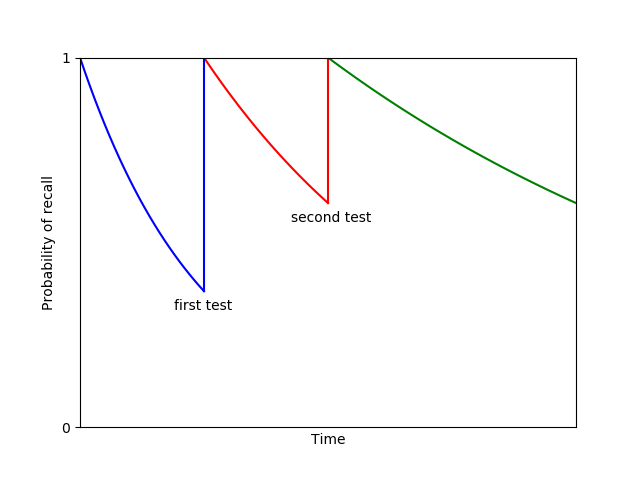
This is now known as the ‘Forgetting curve’. You can see that each time information is forgotten and relearned it will be remembered slightly longer. This is the principle behind spaced repetition. If you know the curve you can tell when each flashcard should be reviewed to achieve an average recall of, say, 90%.
Anki does all of this for you. When it shows you a card you have two to four options:
- Again
- Hard
- Good
- Easy
The longer a card has gone without being forgotten (not picking ‘Again’) the longer it will be before Anki shows it to you again. On the other hand, if you forget a card this time resets back to the start.
My Experience
As of this post I have 922 cards in my Italian deck. 541 of these are ‘mature’, 350 are ‘young’, and 24 are ‘suspended’. The vast majority of these cards are just single words. Common verbs, nouns, adjectives, etc. Some of them are more interesting, such as the cards I use to memorise conjugations. These have a verb, tense, and a place to write in the conjugation for each of the six subjects.
Ideally, Anki works best if you review cards each day and introduce some small number of new cards each day (20 is the default). When I committed to this I didn’t find it that difficult. However, when the first test approached I added a large number of cards. Realising I wouldn’t see them all before the exam I panicked and increased the new card limit to 40, then 80, then 100…

Then the exam hit and I lost all motivation to study. Highest peak on that graph is one day in the holidays where I paid for all the reviews I had missed. That day I reviewed about 750 cards taking me almost two hours. After the holidays I eventually got back into the habit. In the second half of the semester we weren’t introduced to that much new vocab, hence the smaller number of new cards.
Overall I’ve spend approximately 14 hours studying these cards, studying an average of 20 minutes a day. Anki helpfully tells me (I imagine in the tone of a used car salesman) that this could be as low as 11 minutes if I studied every day.
The average time between seeing a card in my deck twice is 1.3 months. The longest card has an interval of 5.1 months. ‘Finire’, to finish.

It’s Not A Silver Bullet
Unfortunately, as useful as spaced repetition is, it’s not a silver bullet. Here are four things you should know before you try spaced repetition yourself:
- Anki is not designed to help you learn it’s designed to help you remember. You should ideally have already seen the word/formula/thing at least once before you create a card for it.
- Creating good cards take time. For vocabularry you can often get away with just the word on the card. As soon as it gets more complicated than that cards like this will be very difficult to remember. Which leads on to:
- Adding context, pictures or diagrams will make it much easier to remember. Connections to things you already know help enormously in recall.
- Don’t add too many new cards at once. For me, about 50 new cards a day on top of regular reviews is about the limit. More than that and the number of reviews becomes overwhelming and I get burnt out. Find your limit, and stick to it.
An Ending
I’ve learnt a lot using Anki and even if I decide to stop reviewing my Italian deck after exams it’ll be a useful tool to have whenever I have something I want to remember.
So try it out, what do you want to remember?
 Science Scholars 2019